Check the rules before you pack
A medication that is routine at home may be restricted or require paperwork elsewhere. Before an international trip, check the requirements for every country you will enter, including any country where you plan to leave the airport during a connection. Rules can differ for controlled medicines, injectable drugs and the quantity a traveler may bring. If a requirement is unclear, contact the destination’s embassy, consulate or relevant health authority well before departure.
Make a list of each medication’s generic name, brand name, strength and prescribed dose. Brand names can vary between countries, so the generic name is especially useful when asking questions or explaining what you carry. Check rules for the medicine itself and for any associated supplies, such as syringes or needles. Allow time to obtain any required authorization; a prescription alone may not satisfy every destination’s rules.
If your trip includes several borders, check each one rather than assuming that permission in one country applies to the next. This matters on cruises, overland routes and itineraries that may change after booking. Keep copies of any approvals where you can access them without an internet connection.
Prepare your supply and documents
Work out how much medication you will need for the full trip, including travel days, then ask your prescriber or pharmacist about an appropriate allowance for possible delays. Refill policies and destination quantity limits may affect what you can bring, so address both before relying on extra doses. Do not change your prescribed dose to make a supply last longer.
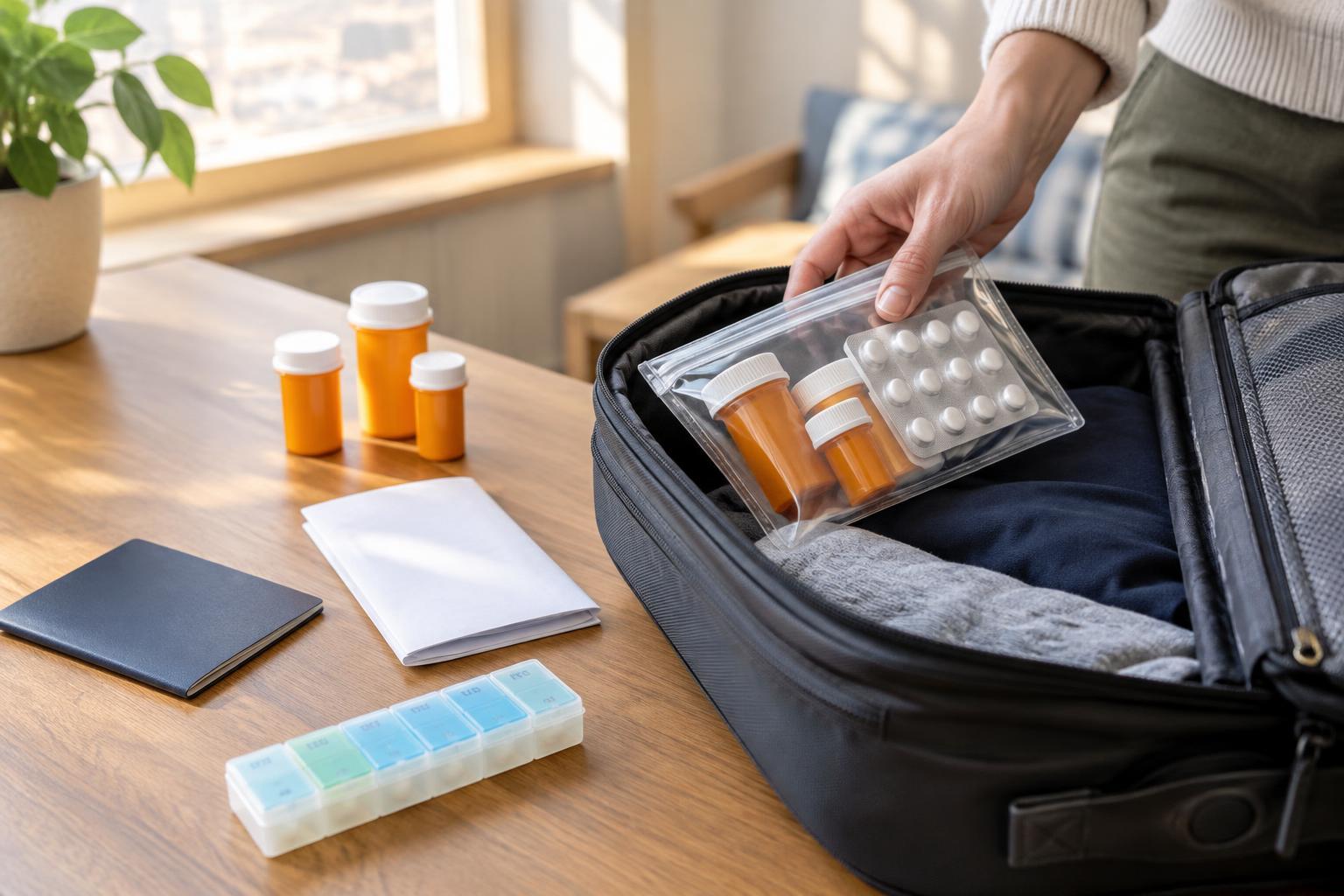
Whenever possible, carry medication in its original, labeled container. The label helps connect the medicine to your name and dosing instructions, while a separate medication list makes the details easier to find. Ask your prescriber whether a signed letter describing your medications and any necessary equipment would be helpful or required for your route. A copy of your prescription may also be useful, but neither document guarantees entry where a substance is restricted.
Store digital copies of your documents as a backup, and keep paper copies separate from the originals. If you travel under a different name from the one on your prescription label, bring documentation that helps explain the difference. Keep sensitive medical information in a secure place rather than in an exposed luggage pocket.
Keep medication accessible in transit
Pack essential medication in your carry-on or personal item, where you can reach it during delays and where it is less likely to be separated from you by a missing checked bag. If your carry-on may be checked at the gate, move medication and required supplies into the smaller bag that stays with you. Leave enough room to retrieve items for security screening without unpacking your entire bag.
Check the security requirements of each airport on your route, especially for liquid medicines, cooling materials, needles or medical devices. Tell screening staff when you are carrying items that need special handling, and allow extra time. A clear pouch can keep related supplies together, but keep prescription labels and documents easy to show if requested.
For medication that needs refrigeration or protection from heat or freezing, ask your pharmacist about its permitted storage range and how long it can safely remain outside it. Choose a travel case suited to those instructions rather than assuming an ice pack is enough. Avoid leaving medicine in a parked vehicle or in direct sun, and confirm in advance whether your accommodation can meet its storage needs.
Plan for schedules and disruptions
Crossing time zones can make a familiar dosing routine confusing. Before departure, ask your pharmacist or prescriber how to handle the change if timing matters for your medication. Write the agreed schedule down in a format you can use in transit, with both home and local times if that helps. Set reminders carefully: a phone may update its time zone automatically, while a handwritten note will not.
Keep a simple inventory so you know what you packed and how much remains, particularly on a long trip. Consider dividing the supply between two accessible bags if the storage requirements and local rules allow it, while keeping each portion properly labeled. Never rely on buying a replacement abroad: the same medicine may have a different name, require a local prescription or be unavailable.
If medication is lost, damaged or delayed, your list of generic names, doses and prescriber contact details can help you explain the situation to a local pharmacist or clinician. Travel insurance may offer an assistance line, but check your policy before departure to understand what support it provides.
Make a final predeparture check
A few days before leaving, put your medication, documents and necessary equipment together and compare them with your itinerary. Confirm that you have enough supply for the planned trip, that any required permissions are in place, and that your storage plan works during flights, transfers and stays. Keep your next scheduled dose somewhere easy to reach, not at the bottom of a tightly packed case.
The goal is not to carry a folder of paperwork for every possibility. It is to know the rules for your route, protect the medicine you depend on and have the information needed if a question or delay arises. With those steps settled, your packing list can return to the more enjoyable parts of the trip.